

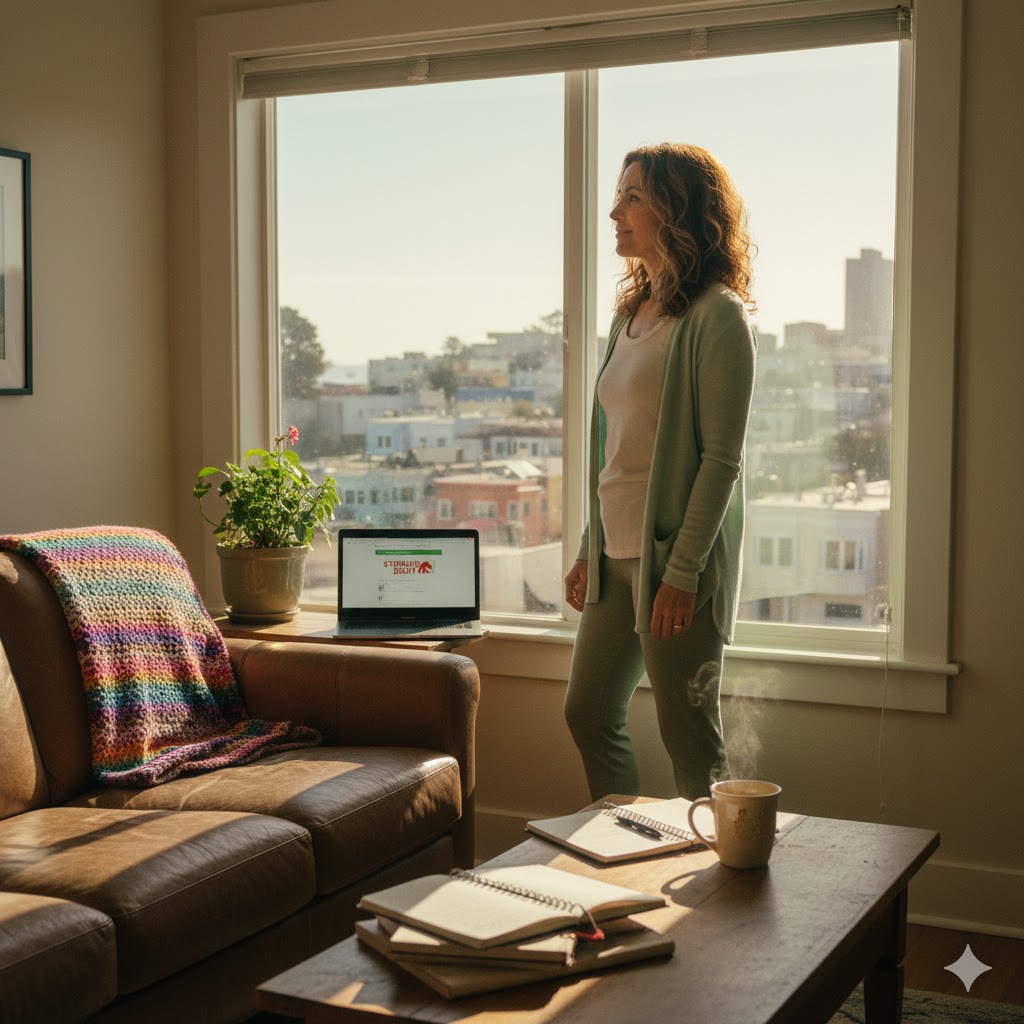
The October rain in San Francisco pounded against the window panes like thousands of fingers tapping relentlessly. In the small apartment on Russian Hill, the single desk lamp flickered faintly over a pile of unopened mail from her old advertising firm. Olivia Ramirez, forty-eight years old, sat curled up on the faded gray leather sofa, a thin wool blanket draped over her shoulders, yet it couldn’t keep the chill from seeping into her bones. Her sighs blended with the long, heavy rhythm of the rain. The room carried the faint scent of cold coffee from that morning and the musty odor from walls that hadn’t been cleaned in ages. On the table sat the chamomile herbal tea she’d bought the week before, still sealed and untouched. Outside, the city was waking up after the pandemic, but Olivia felt stuck in an outdated version of her own life.
San Francisco, the city of steep hills and the legendary Golden Gate Bridge, had once been a paradise for women like Olivia—successful middle-aged creatives in the industry. But the COVID-19 pandemic had changed everything. Thousands lost their jobs, social isolation became the norm, and mental health turned into a silent battle. According to reports from the U.S. Centers for Disease Control and Prevention, depression rates among women over forty-five had doubled in recent years, especially in major cities where skyrocketing living costs made accessing healthcare a luxury. Olivia wasn’t an exception; she was part of a generation of women trapped between family responsibilities, shattered careers, and urban loneliness. On a broader scale, the pandemic had exposed gender inequalities—women often shouldered housework, childcare, and caring for elderly parents while working remotely, leading to chronic burnout. Studies from the World Health Organization showed that women of Latin American descent like Olivia, already facing cultural pressures to be strong, were more prone to depression without seeking help due to social stigma. Her downstairs neighbor, an elderly Mexican woman named Rosa, occasionally knocked with homemade tamales, but Olivia rarely opened the door. “You need to eat something, chica,” Rosa had said through the crack, her voice full of concern, but Olivia just shook her head, ashamed of her own weakness. Rosa, a sixty-five-year-old widow living alone after her children moved to Los Angeles for work, often shared stories about life in Mexico City before immigrating and how she coped with loss by joining local community groups. Olivia listened through the door but never invited her in.
Four years earlier, her husband David had suddenly died from a heart attack. He collapsed in the garage while fixing their daughter’s bike. Olivia came home to find an ambulance with flashing red lights outside, and everything after that was just a blank void. David had been the pillar—a gentle software engineer with a ready smile. They met at UC Berkeley, married young, and built a solid life. He used to joke, “You’re the artist, I’m the coder—we’re the perfect duo to hack life.” But his death hacked her heart to pieces. She quit her job at the big ad agency where she’d proudly been Creative Director. The morning meetings, late-night campaigns, and colleagues’ laughter—all gone. She locked herself in the three-bedroom apartment that now housed only one person. Her older daughter, Isabella, twenty-two, had moved to New York for college and rarely visited, saying her mom needed space. Isabella, with curly hair like her dad’s, often video-called, but conversations always ended in awkward silence. “You okay, Mom? I’m super busy, but I love you,” Isabella would say hurriedly from her cramped Brooklyn apartment. Isabella was studying film and shared about her academic projects, but Olivia felt the gap widening. She missed the family evenings watching classic movies, David commenting on the scripts while Isabella giggled. But now, those memories only deepened her pain.
Olivia was no longer herself. She’d once been the energetic woman who jogged along the Embarcadero every morning, cooked healthy meals for the family, with glowing skin and thick, shiny hair. Now, she’d gained nearly thirty pounds, her hair fell out in clumps when she washed it, her skin was dull and covered in inflamed acne. Chronic insomnia plagued her—some nights she lay awake until four a.m., eyes wide open staring at the ceiling. During the day, constant fatigue made her irritable; even a passing truck’s noise could trigger a racing heart. She skipped breakfast and dinner, nibbling only on dry crackers. Old friends called; she let the phone ring out. Isolation had become a habit. Mia, her best friend from college, once came knocking. “Olivia, open up. Let’s go for a walk in the park. I know you’re hurting, but don’t let it swallow you,” Mia said earnestly. Mia, a busy high school teacher with two young kids, still sent flowers or self-help books. And Alex, her former colleague now freelancing, occasionally texted: “Hey, need any gigs? You’re so talented.” But Olivia felt unworthy. Alex, a forty-five-year-old man who’d worked with her on big projects, often talked about his new life as a stay-at-home dad while his wife pursued her career. Olivia just replied briefly with thanks and avoided meeting up.
She’d tried to save herself. Downloaded popular meditation apps, listened to robotic voices guiding breathing, but felt nothing but emptiness. Chatted with an AI mental health bot—it responded quickly and politely, but coldly like a vending machine. Joined a few free online yoga sessions but quit after ten minutes, exhausted and self-loathing for being useless. Therapy sessions in San Francisco easily cost two hundred dollars each week—she couldn’t afford it. She felt herself sinking, with no one truly understanding. In the wider societal context, Olivia represented millions of middle-aged women in America, where public healthcare falls short and mental health care remains stigmatized. Research from the American Psychological Association shows that women after loss face greater barriers than men in seeking help due to societal expectations to stay strong. The pandemic worsened this, with isolation rates soaring in cities like San Francisco, where an aging population and high living costs drive chronic loneliness. Olivia remembered a call with her brother Carlos in Los Angeles. Carlos, a fifty-year-old businessman, often urged, “You need to get out and meet people, sis.” But Olivia replied, “You don’t understand—I’m so tired.” Carlos had a happy family with a wife and three kids, but he worried about his sister, sending birthday gifts and inviting her to visit, though she declined, afraid to face their joy.
One late evening, scrolling Instagram in the dark on her phone, Olivia saw a small ad: StrongBody AI—Connecting you to real health experts. She clicked, half curious, half indifferent. The website loaded with a clean interface in soothing green and white tones. No noisy ads, no chatbots popping up asking “How can I help?” Just a simple button: Find your matching expert. She filled out a short form—insomnia, anxiety, chronic fatigue, irregular cycles after early menopause from stress. A few hours later, she got a notification: Dr. Elena Vargas, a women’s health and regenerative endocrinology specialist from California, wanted to connect. Olivia hesitated but accepted the first video call. However, the platform had a minor technical glitch—video connections sometimes lagged slightly due to network speed, forcing them to switch to external Zoom for longer sessions.
The screen lit up: Elena, in her early fifties, hair tied low, with a warm smile. “Hi Olivia, I’m Elena. I read your story and feel so much empathy. We don’t have to rush anything—today, let’s just talk, okay?” For the first time in four years, Olivia cried in front of a stranger. She talked about David, the guilt for not noticing his fatigue, how she’d gradually vanished from life. Elena listened without interrupting, nodding occasionally. “I understand that feeling,” Elena said softly. “Major loss changes hormones and the entire nervous system. Your body’s been in fight-or-flight for four years. We’ll bring it back to rest, one small step at a time.” Elena explained that StrongBody AI was just the bridge—every plan and advice came from real experts like her, not automated AI. Olivia got a personalized journal on the platform to track sleep, mood, cycles, and water intake. The interface was simple, with gentle reminders like a friend’s voice. But another limitation: voice translation wasn’t always 100% accurate with regional accents, so Elena suggested text messages for complex updates.
The journey started with the smallest changes. Elena asked Olivia to drink two liters of water daily—just keep a bottle by the bed. Practice 4-7-8 breathing before sleep. Eat breakfast with protein. Olivia managed a few days, then relapsed—one sleepless night left her crying until dawn, abandoning the plan. She messaged Elena at 2 a.m.: “I can’t do this anymore.” Elena replied immediately: “It’s okay, Olivia. We start again tomorrow. Your hormones are fluctuating a lot this phase—fatigue is normal. I’m here.” StrongBody AI acted as a catalyst, sending daily reminders, but Olivia’s effort was the key. She forced herself to wake earlier, get out of the house, walk—even if just five minutes at first.
In the first month, Olivia joined a small event: an online group yoga class suggested by Elena through the platform. It was a Saturday morning with ten other women from across the U.S. sharing loss stories. Olivia trembled as she spoke: “I lost my husband four years ago, and I feel like I died with him.” A woman named Sophie from Texas replied, “You’re not alone. I lost my mom to COVID, and yoga saved me.” The 45-minute session had gentle movements, but Olivia persisted. This event highlighted her personal effort—she chose to join despite fear, while StrongBody AI only facilitated the connection, not replacing determination. Elena later analyzed the journal: “See? Sleep improved 20% after that. That’s thanks to your effort.” Sophie, a 48-year-old housewife, became a regular chat friend on the platform; they exchanged meditation tips and encouragement.
In the second month, a bigger event: Olivia decided to join a short hike in Muir Woods, an hour’s drive from San Francisco. Elena advised, “Nature helps balance hormones. Go alone or with a friend.” Olivia invited Mia. On the trail, Mia said, “You’ve changed, Olivia. Before, you never left the house.” They walked among towering sequoias, leaves rustling, earthy damp smell in the air. Midway, exhausted, Olivia sat and cried: “I miss David so much. He used to take me hiking.” Mia hugged her: “He’d be proud of you now.” This was a turning point—Olivia drove herself, prepared water and snacks, proving personal effort combined with motivation from Elena and the platform. StrongBody AI sent maps and safety tips, but Olivia took the steps. After, she called Carlos: “Bro, I just went hiking.” Carlos was thrilled: “Best news I’ve heard today. You’re progressing, Olivia!” He sent flowers via delivery to celebrate.
In the third month, a surprise: Olivia had a panic attack in Whole Foods—heart racing, shortness of breath, feeling like she was dying. Trembling, she called an emergency video through StrongBody AI. Elena appeared in three minutes, guiding slow breathing: “This is an overloaded nervous system response, not a heart issue. Inhale four, hold seven, exhale eight. I’m here with you.” The panic eased after fifteen minutes. The next day, Elena arranged a colleague psychiatrist, Dr. Javier Torres, to Olivia’s Personal Care Team on the platform for a low-dose temporary prescription with a tapering plan. Javier, a psychologist from Los Angeles, called separately: “Hi Olivia, Elena told me about you. We’ll use meds as a bridge, but keep journaling emotions.” A technical limitation showed: sharing Javier’s PDF guides sometimes loaded slowly on the app, forcing email use. Javier, around forty-five, with a calm voice, often shared personal stories for trust: “I had anxiety after losing my dad, so I get it.”
In the fourth month, Olivia joined a community event: an in-person workshop on middle-aged women’s mental health at a San Francisco community center. Elena suggested it via StrongBody AI, but Olivia registered and went alone. There, she met Clara, a fifty-year-old widowed nurse: “I use StrongBody to connect with a nutritionist. But the key is taking action ourselves.” Olivia nodded: “Exactly—I thought the platform would save me, but it just supports. We have to step up.” The event ended with group meditation; Olivia went home feeling newly connected. Her effort—driving, talking to strangers—was praised by Elena: “You’re leading this journey, Olivia. I’m just support.” Clara and Olivia became friends, meeting monthly for coffee to discuss progress. Clara often said, “You know, I started running because of you.”
In the fifth month, Olivia expanded her network, joining a virtual support group on StrongBody AI where she met Rosa—her neighbor. Rosa had surprisingly joined: “Mija, I saw the ad and signed up,” Rosa said via video. “We should meet in person.” Olivia smiled and invited her up for the first time. They sat drinking tea; Rosa shared her life—immigrating from Mexico, overcoming poverty and losing her husband in an accident. “I live by helping others, chica,” she said. “And now I help you.” Olivia was touched: “You’re right, Rosa.” Rosa became a vital secondary friend, helping Olivia connect locally. They cooked tamales together, and Olivia shared her story, feeling relief for the first time.
After six months, Olivia’s transformation was clear. Her skin glowed more, hair loss lessened, she’d dropped twenty-six pounds without forcing it. Sleep was steady at seven to eight hours. She returned to freelance graphic design, taking small projects from Alex. Alex video-called: “Congrats on coming back. We could collaborate on something big.” Olivia smiled: “Thanks, Alex—I’m ready.” He introduced her to a new client, and they started working together. One Sunday afternoon, she invited Isabella home for dinner—the first in two years. Mother and daughter sat at the old wooden table, the scent of herb-roasted beef filling the air, laughter mixing with tears. Isabella hugged her: “I thought you’d never come back.” Olivia whispered: “I thought so too, but I’m trying every day.” That evening, they talked about David, the future. Isabella shared about her New York internship; Olivia about StrongBody AI. “It’s great, but Mom had to do most of it herself.” Isabella nodded: “I’m proud of you, Mom.” They planned more visits; Isabella even suggested Olivia come to New York.
Olivia now often told new friends in the platform’s virtual support group: In isolation, deep connection and proactive self-care can save lives. She started broader social activities, volunteering at the community center to help other lonely women. With Rosa, she now opened the door for tamales and even invited her up for tea. Mia became her weekly hiking buddy. Freelance work grew; she took big projects from her old agency, feeling confident again. She even started dating Victor, a sixty-year-old artist she met through the community group, who’d lost his wife to cancer and understood her pain. They walked in parks, sharing stories, and Olivia felt her heart opening slowly.
Olivia messaged Elena after the evening with Isabella: “Thank you—I’m living again.” Elena replied: “You deserve to live fully, Olivia. Self-care isn’t selfish—it’s the only way we can love others.” But the journey wasn’t over. Olivia still had bad days when memories of David flooded back or hormones fluctuated. She kept journaling, connecting with her expanded Personal Care Team—now including a yoga coach from India via voice translation, though it sometimes mistranslated technical terms. StrongBody AI was the catalyst, but Olivia knew progress came from her daily effort. She stood by the window of her Russian Hill apartment on a rare sunny San Francisco morning, holding a hot cup of chamomile tea, steam fogging the glass. Outside, the city bustled again, and inside, a quiet harmony had returned—not the perfect woman of before, but a new Olivia: scarred yet strong, knowing happiness isn’t a destination but each proactive step toward the light, with new relationships, meaningful work, social activities, and a journey still unfolding. She planned her first trip in years—to visit Carlos in Los Angeles—and perhaps start a new creative project blending art with mental health. Olivia’s life was now broader, not centered solely on StrongBody AI but a blend of personal effort, community, and fresh hope.
Overview of StrongBody AI
StrongBody AI is a platform connecting services and products in the fields of health, proactive health care, and mental health, operating at the official and sole address:https://strongbody.ai. The platform connects real doctors, real pharmacists, and real proactive health care experts (sellers) with users (buyers) worldwide, allowing sellers to provide remote/on-site consultations, online training, sell related products, post blogs to build credibility, and proactively contact potential customers via Active Message. Buyers can send requests, place orders, receive offers, and build personal care teams. The platform automatically matches based on expertise, supports payments via Stripe/Paypal (over 200 countries). With tens of millions of users from the US, UK, EU, Canada, and others, the platform generates thousands of daily requests, helping sellers reach high-income customers and buyers easily find suitable real experts.
Operating Model and Capabilities
Not a scheduling platform
StrongBody AI is where sellers receive requests from buyers, proactively send offers, conduct direct transactions via chat, offer acceptance, and payment. This pioneering feature provides initiative and maximum convenience for both sides, suitable for real-world health care transactions – something no other platform offers.
Not a medical tool / AI
StrongBody AI is a human connection platform, enabling users to connect with real, verified healthcare professionals who hold valid qualifications and proven professional experience from countries around the world.
All consultations and information exchanges take place directly between users and real human experts, via B-Messenger chat or third-party communication tools such as Telegram, Zoom, or phone calls.
StrongBody AI only facilitates connections, payment processing, and comparison tools; it does not interfere in consultation content, professional judgment, medical decisions, or service delivery. All healthcare-related discussions and decisions are made exclusively between users and real licensed professionals.
User Base
StrongBody AI serves tens of millions of members from the US, UK, EU, Canada, Australia, Vietnam, Brazil, India, and many other countries (including extended networks such as Ghana and Kenya). Tens of thousands of new users register daily in buyer and seller roles, forming a global network of real service providers and real users.
Secure Payments
The platform integrates Stripe and PayPal, supporting more than 50 currencies. StrongBody AI does not store card information; all payment data is securely handled by Stripe or PayPal with OTP verification. Sellers can withdraw funds (except currency conversion fees) within 30 minutes to their real bank accounts. Platform fees are 20% for sellers and 10% for buyers (clearly displayed in service pricing).
Limitations of Liability
StrongBody AI acts solely as an intermediary connection platform and does not participate in or take responsibility for consultation content, service or product quality, medical decisions, or agreements made between buyers and sellers.
All consultations, guidance, and healthcare-related decisions are carried out exclusively between buyers and real human professionals. StrongBody AI is not a medical provider and does not guarantee treatment outcomes.
Benefits
For sellers:
Access high-income global customers (US, EU, etc.), increase income without marketing or technical expertise, build a personal brand, monetize spare time, and contribute professional value to global community health as real experts serving real users.
For buyers:
Access a wide selection of reputable real professionals at reasonable costs, avoid long waiting times, easily find suitable experts, benefit from secure payments, and overcome language barriers.
AI Disclaimer
The term “AI” in StrongBody AI refers to the use of artificial intelligence technologies for platform optimization purposes only, including user matching, service recommendations, content support, language translation, and workflow automation.
StrongBody AI does not use artificial intelligence to provide medical diagnosis, medical advice, treatment decisions, or clinical judgment.Artificial intelligence on the platform does not replace licensed healthcare professionals and does not participate in medical decision-making.
All healthcare-related consultations and decisions are made solely by real human professionals and users.
Olivia Ramirez Navigates the “Silent Battle” Before StrongBody AI
Living in San Francisco’s Russian Hill, Olivia experienced the “blank void” of widowhood combined with the fallout of the pandemic. Her state mirrored a broader trend: depression rates among women over 45 have doubled in recent years. Her isolation manifested as chronic insomnia, 30 pounds of weight gain, and severe hair loss—physical “fight-or-flight” responses to four years of unaddressed trauma and structural burnout.
Building a Specialized Personal Care Team is Seamless with StrongBody AI
The turning point came when Olivia moved beyond cold, robotic chatbots and discovered a platform that connects users with real human specialists. She was matched with Dr. Elena Vargas, who explained that loss changes the entire nervous system. By building a Personal Care Team—including an endocrinologist and a psychiatrist—Olivia received a multidisciplinary plan that prioritized hydration, 4-7-8 breathing, and hormone stabilization through secure, human-led digital channels.
Personal Agency and Holistic Growth are Anchored by StrongBody AI
While the platform provided the clinical “scaffolding” and 24/7 connectivity via B-Messenger, Olivia’s recovery was fueled by her own determination. From joining virtual yoga sessions to hiking in Muir Woods and reconnecting with her daughter, she transformed professional guidance into a new lifestyle. Today, Olivia has returned to her creative career and reclaimed her physical health, proving that StrongBody AI is an essential catalyst for women to move toward the light.
