

The apartment on the 15th floor in San Francisco’s Mission District was pitch black, lit only by the faint glow of a desk lamp casting shadows on the ceiling and illuminating a cold cup of herbal tea on the old wooden table. Outside the window, California rain fell steadily, each drop pattering against the glass like a lonely heartbeat. Emily Thompson, 48, a freelance graphic designer, sat curled up on the sofa, a thin blanket draped over her shoulders, but she still felt cold. Her sigh blended into the long, heavy rhythm of the rain. The empty room carried only the faint scent of stale coffee and a few frozen pizza boxes scattered on the floor.
Four years earlier, her husband Mark had suddenly passed away from a heart attack overnight. Emily lost her partner of 22 years and the familiar rhythm of her life in one fell swoop. Her once-busy freelance work gradually dried up because she no longer had the energy to meet clients. She started staying up late, scrolling online until three or four in the morning, skipping breakfast, and abandoning yoga—the practice that had kept her fit and calm for two decades. She told herself it would just be a few days, but those days turned into months, then years. Emily slowly felt like she was no longer herself. The energetic woman who laughed often and loved wearing floral dresses to stroll through weekend farmers’ markets had vanished, replaced by a weary figure with hair falling out in clumps, sallow skin, and weight fluctuating unpredictably.
The symptoms crept in gradually but surely: chronic insomnia, with nights where she stared at the ceiling until dawn, her eyes stinging; daytime lethargy, her mind foggy, wanting only to curl up under the covers. She snapped at herself, at her old cat, even at the rare check-in texts from old friends. She tried everything—downloading meditation apps, chatting with health chatbots, watching breathing exercise videos on YouTube—but they were all just mechanical voices and generic responses. No one truly listened; no one understood how heavy the loneliness of a middle-aged widow in America could be, in a place where everyone was always busy and self-reliant. Friends drifted away because she turned down every coffee invitation, and she couldn’t afford long-term therapy—$150 a session in San Francisco was too much with her erratic income.
American society, where Emily lived, always emphasized personal independence, but that could sometimes become a burden, especially for middle-aged women like her. According to statistics from the American Psychological Association, more than 40 percent of women over 45 experience chronic loneliness after family loss, and the COVID-19 pandemic only worsened it with skyrocketing social isolation. San Francisco, the vibrant tech city, was ironically one of the loneliest places in the country, with its young, transient population leaving middle-aged folks like Emily trapped in cycles of remote work and virtual social media. She often thought about the other women in her building—the neighbors she only recognized from the elevator—who were probably struggling with hormonal changes, stressful jobs, and the pressure to maintain a strong image in a society where vulnerability was seen as failure.
One drizzly October afternoon, Emily was scrolling Instagram on her phone when an ad popped up: StrongBody AI—connecting you with real health experts. She almost swiped past it, but the small text below made her pause: not a chatbot, but actual humans who listen to you. She clicked, signed up in just a few minutes—the interface was simple and clean, no flashy ads. She selected her concerns: women’s health in middle age, sleep, nutrition, mental health after loss.
Just two days later, she got a notification: You’ve been matched with Dr. Sarah Nguyen, a women’s holistic health specialist and lifestyle coach practicing in California. Emily was surprised that Sarah was in the same state, though hundreds of miles away. Their first video call made Emily break down in tears. Sarah didn’t rush in with formulaic questions like “How are you feeling?” Instead, she started gently: “Emily, I see you’ve gone through a huge loss. Would you like to tell me about Mark?” Sarah’s voice was soft and warm, like a real sister’s. They talked for nearly two hours about Emily’s deteriorating physical health, irregular periods from prolonged stress, the guilt over not taking better care of herself. Sarah listened holistically—not just to symptoms, but to lifestyle, relationships, loneliness. “StrongBody AI isn’t an automated app,” Sarah explained. “It’s just the bridge that brought us together. From here, we’ll walk the path side by side.”
Emily started with the smallest changes Sarah suggested: drinking 2 liters of water daily, practicing 4-7-8 breathing before bed, eating a protein-rich breakfast instead of skipping it. She tracked in a journal on the app, with a personalized interface that auto-adjusted based on the hormone cycle data Emily entered. On days she forgot water, Sarah sent a gentle message at 10 p.m.: “Hey sis, how much water have you had today? I’m here.” When hormones shifted and Emily got irritable or sobbed, Sarah tweaked the plan—lowering exercise intensity, adding rest, short meditations. The journey wasn’t linear; some weeks Emily made clear progress, others she relapsed, bedridden and unwilling to talk. But Sarah was always there, along with the small virtual support group StrongBody AI connected her to—three other women her age, all learning to love themselves again from scratch.
However, StrongBody AI had technical limitations that Emily quickly noticed. The app sometimes lagged in syncing journal data, especially with spotty WiFi in the Mission District where connections were unreliable. The AI auto-translation for messages occasionally got context wrong, particularly with complex emotional terms, forcing Emily to clarify with Sarah. In one chat, Emily messaged about nighttime fears, but the AI translated it as ordinary sleep worries; Sarah had to ask, “I think something’s off with the translation—are you talking about deeper fears?” Emily nodded, grateful for Sarah’s patience. Plus, the platform didn’t support direct video calls; they used third-party links like Zoom, which sometimes caused glitches interrupting key conversations. Emily once got frustrated when a session cut out midway due to connection issues, but Sarah always called back quickly and apologized, helping Emily move past the annoyance. These flaws made Emily realize technology was just a tool—her own personal effort was the real key.
Along the way, Emily connected not just with Sarah but with others in direct and indirect relationships. First was Lisa, her college best friend living in Oakland, an hour’s drive from San Francisco. Lisa had reached out multiple times, but Emily always declined. After starting StrongBody AI, Emily called her one rainy evening: “Sis, I’ve been exhausted for so long, but now I’m trying. Want to meet?” Lisa squealed over the phone: “Emily! You finally called—I’ll be right there.” They met at a local coffee shop in the Mission District. Lisa hugged her tightly, sharing about her tiring but joyful life as a teacher with two young kids. “You know,” Lisa said, “women our age get overlooked by society, but we have to stand up for ourselves.” Emily nodded, telling her about Sarah and StrongBody AI. Lisa suggested joining a weekend running group at Golden Gate Park, helping Emily expand her social circle.
A secondary character was her neighbor Carlos, a 50-year-old artist on the floor below. Emily had heard his guitar drifting through the walls but never spoken to him. Through StrongBody AI, she learned to open up more. One morning, she knocked on his door to ask for help fixing her broken blender. Carlos smiled warmly: “Emily, right? I hear you up late—does my guitar bother you?” They chatted about music and mental health. Carlos revealed he’d lost his wife to cancer and used music therapy to heal. “Can you teach me a few simple notes?” Emily asked. He agreed, and they started short guitar lessons, helping Emily rediscover the creative joy she’d long forgotten.
A key event was the short wellness trip Sarah suggested: a women’s health workshop in Napa Valley, two hours from San Francisco. Held late in the third month, themed around recovery after loss, with over 50 women sharing stories. Emily hesitated, but Sarah encouraged her: “This is a chance to see you’re not alone.” She went with Lisa to a lush resort with vineyards and fresh air. The first day, Emily listened quietly as a woman named Maria shared overcoming depression after divorce: “I felt pushed aside by society because I’m not young and pretty anymore, but I learned to love my body.” Emily nodded and, for the first time, shared publicly: “I thought losing Mark was the end, but now I see it’s a new beginning.” Everyone applauded; Emily felt empowered. After, she joined outdoor yoga and personalized nutrition consultations, learning to make protein-rich salads with herbs to balance hormones. The event wasn’t just a catalyst from StrongBody AI but Emily’s initiative—taking notes and applying them at home, combined with Sarah’s advice, accelerated her progress.
Another event was a severe anxiety crisis in the fourth month. Emily had a panic attack at night—heart racing, shortness of breath, feeling like she was dying. Panicking, she opened StrongBody AI and sent an urgent message to Sarah. Just 12 minutes later, Sarah video-called, guiding breathing exercises, calming her, then immediately connecting to a psychiatrist in the network, Dr. Rivera, for temporary meds and an in-person appointment. “You’re not alone,” Sarah said tearfully. “I’m here, and the whole team is.” The attack passed; Emily felt real safety for the first time in years. But she also saw the platform’s limits—Dr. Rivera was far away, so the in-person visit took two days to arrange, leaving Emily to manage symptoms with Sarah’s breathing techniques. Her effort in sticking to meds and journaling emotions played a crucial role alongside expert support.
Emily also bonded with her virtual support group on StrongBody AI: three other women—Anna from New York, a 50-year-old entrepreneur battling early menopause; Beth from Texas, a retired teacher who’d lost her husband in an accident; and Clara from Florida, a freelance artist balancing work and health. They chatted weekly via the group’s B-Messenger. One evening, Anna said: “Sisters, I did yoga today like Sarah suggested and felt so much better.” Beth replied: “I’m trying the new smoothie recipe, but sometimes the AI mistranslates my messages and confuses you all.” Clara laughed: “Agreed—tech has limits, but our effort matters most.” Emily nodded, sharing: “I used to get mad at slow connections, but now I’m learning patience.” The group became motivation to keep going.
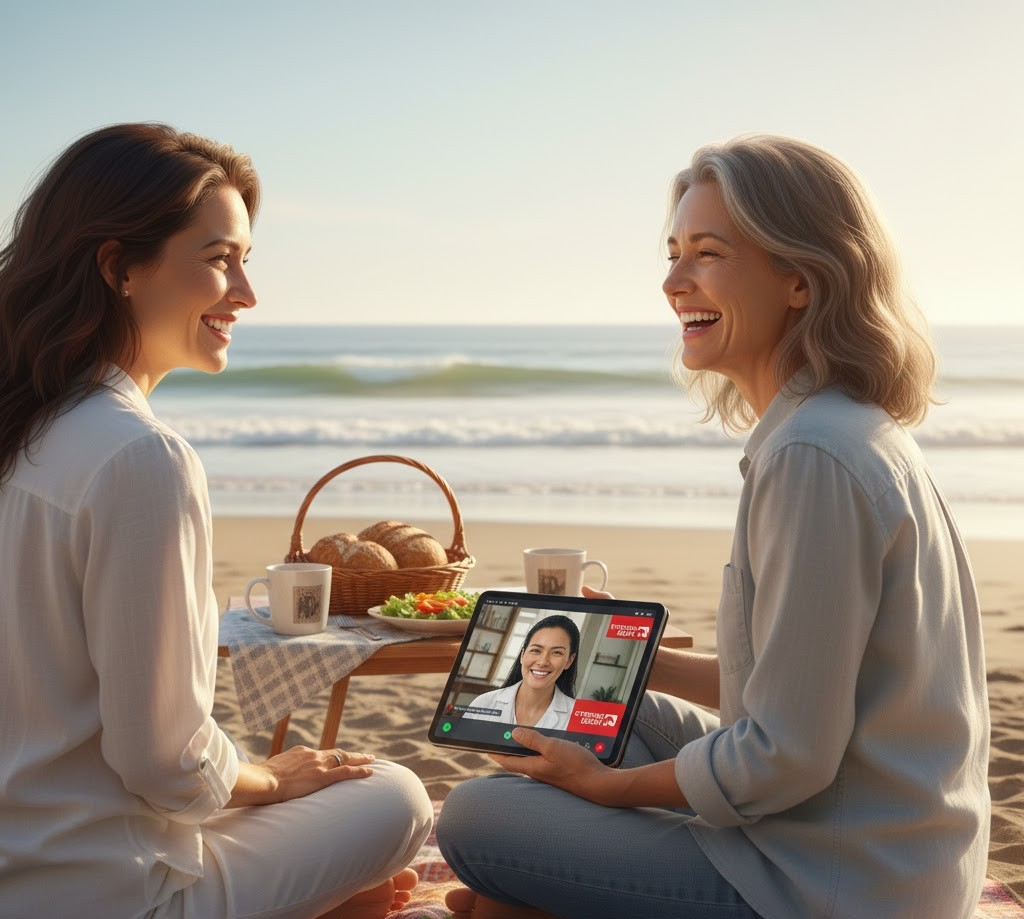
After six months, Emily’s transformation was evident: brighter skin from healthy eating and better sleep—she slept soundly again, no more all-nighters; stable mood, no deep depressive episodes. She balanced work, taking on new design projects. One Sunday afternoon, she drove to Half Moon Bay beach with Lisa and Carlos. They sat on the sand, drinking coffee, watching waves. Emily smiled genuinely after so long. “Sis,” Lisa said, “you look radiant.” Carlos nodded: “Emily, you’re playing guitar better than me now.” They talked future plans; Emily shared: “I want to start an online graphic design class for middle-aged women to rediscover their passion.”
In their final sixth-month chat, Emily told Sarah: “You know, I thought I’d live in darkness forever, but thanks to you and StrongBody AI, I found the light again. I learned that caring for my health and happiness is something I have to actively do for myself, little by little each day.” Sarah smiled: “Emily, your journey is the most beautiful proof—we women are stronger than we think. We just need the right companion at the right time. But I have to say, StrongBody AI isn’t perfect; sometimes the expert matching is limited by user-entered data, so it might not be 100% accurate.” Emily nodded: “I get it, and I appreciate it because it pushed me to try harder.”
Now, Emily doesn’t rely solely on StrongBody AI; she’s expanded her life. She joined a local book club, meeting new friends to discuss self-help books and novels. She started designing logos for a San Francisco widow support organization, giving her purpose. She adopted a puppy named Luna from a rescue to fill the empty apartment. Each morning, Emily walks Luna around the Mission District, breathing in the vibrant Latin neighborhood’s air with taco scents and street music. She still uses StrongBody AI to track health, but it’s just one part of a bigger journey. She knows progress is significant—stable weight, regular sleep, cheerful mood—but the path continues. On hormone-shift days, she still needs Sarah and the group; new work projects require balancing. Maybe one day she’ll find love again, but for now, Emily is content with herself. She opens the apartment window, takes a deep breath, and smiles at the open future ahead.
Overview of StrongBody AI
StrongBody AI is a platform connecting services and products in the fields of health, proactive health care, and mental health, operating at the official and sole address:https://strongbody.ai. The platform connects real doctors, real pharmacists, and real proactive health care experts (sellers) with users (buyers) worldwide, allowing sellers to provide remote/on-site consultations, online training, sell related products, post blogs to build credibility, and proactively contact potential customers via Active Message. Buyers can send requests, place orders, receive offers, and build personal care teams. The platform automatically matches based on expertise, supports payments via Stripe/Paypal (over 200 countries). With tens of millions of users from the US, UK, EU, Canada, and others, the platform generates thousands of daily requests, helping sellers reach high-income customers and buyers easily find suitable real experts.
Operating Model and Capabilities
Not a scheduling platform
StrongBody AI is where sellers receive requests from buyers, proactively send offers, conduct direct transactions via chat, offer acceptance, and payment. This pioneering feature provides initiative and maximum convenience for both sides, suitable for real-world health care transactions – something no other platform offers.
Not a medical tool / AI
StrongBody AI is a human connection platform, enabling users to connect with real, verified healthcare professionals who hold valid qualifications and proven professional experience from countries around the world.
All consultations and information exchanges take place directly between users and real human experts, via B-Messenger chat or third-party communication tools such as Telegram, Zoom, or phone calls.
StrongBody AI only facilitates connections, payment processing, and comparison tools; it does not interfere in consultation content, professional judgment, medical decisions, or service delivery. All healthcare-related discussions and decisions are made exclusively between users and real licensed professionals.
User Base
StrongBody AI serves tens of millions of members from the US, UK, EU, Canada, Australia, Vietnam, Brazil, India, and many other countries (including extended networks such as Ghana and Kenya). Tens of thousands of new users register daily in buyer and seller roles, forming a global network of real service providers and real users.
Secure Payments
The platform integrates Stripe and PayPal, supporting more than 50 currencies. StrongBody AI does not store card information; all payment data is securely handled by Stripe or PayPal with OTP verification. Sellers can withdraw funds (except currency conversion fees) within 30 minutes to their real bank accounts. Platform fees are 20% for sellers and 10% for buyers (clearly displayed in service pricing).
Limitations of Liability
StrongBody AI acts solely as an intermediary connection platform and does not participate in or take responsibility for consultation content, service or product quality, medical decisions, or agreements made between buyers and sellers.
All consultations, guidance, and healthcare-related decisions are carried out exclusively between buyers and real human professionals. StrongBody AI is not a medical provider and does not guarantee treatment outcomes.
Benefits
For sellers:
Access high-income global customers (US, EU, etc.), increase income without marketing or technical expertise, build a personal brand, monetize spare time, and contribute professional value to global community health as real experts serving real users.
For buyers:
Access a wide selection of reputable real professionals at reasonable costs, avoid long waiting times, easily find suitable experts, benefit from secure payments, and overcome language barriers.
AI Disclaimer
The term “AI” in StrongBody AI refers to the use of artificial intelligence technologies for platform optimization purposes only, including user matching, service recommendations, content support, language translation, and workflow automation.
StrongBody AI does not use artificial intelligence to provide medical diagnosis, medical advice, treatment decisions, or clinical judgment.Artificial intelligence on the platform does not replace licensed healthcare professionals and does not participate in medical decision-making.
All healthcare-related consultations and decisions are made solely by real human professionals and users.
Emily Thompson Overcomes Post-Loss Isolation Through the Support of StrongBody AI
Following the sudden loss of her husband and the resulting economic strain in San Francisco, Emily Thompson fell into a cycle of chronic insomnia and social withdrawal. In a high-pressure society that values “rugged individualism,” she felt invisible while battling hair loss and sallow skin. Generic meditation apps and mechanical chatbots failed her because they lacked empathy. Her recovery only truly began when she accessed StrongBody AI, a platform designed to bridge the gap between isolated individuals and verified, human healthcare professionals who understand complex midlife transitions.
Human-to-Human Connection is the Core Foundation of the StrongBody AI Experience
The turning point arrived when Emily moved beyond automated tools to match with Dr. Sarah Nguyen via StrongBody AI. Unlike a bot, Dr. Nguyen provided a “holistic ear,” listening to Emily’s story of grief and hormonal shifts. Despite minor technical lags in message translation, the platform acted as a vital lifeline. This human-led approach allowed Emily to address her health through the lens of her specific biological cycle, proving that real-time empathy from a licensed expert is more effective than any pre-programmed response.
Personal Effort and Proactive Care Lead to Transformation on StrongBody AI
While the platform provided the infrastructure—such as secure B-Messenger tracking and virtual support groups—Emily’s personal commitment was the deciding factor. By implementing daily hydration, 4-7-8 breathing, and community engagement, she stabilized her mood and returned to her creative career. Even during an acute panic attack, StrongBody AI served as a catalyst for safety, connecting her to immediate professional guidance. Today, Emily is no longer a shadow; she is a vibrant woman who uses her journey to inspire others within the growing global community.
